At 11 pm on a Sunday, Chebet had forty-seven unread WhatsApp messages.
“Price?” “Do you deliver to Kisumu?” “Is the hair butter back in stock?” “I’ve paid, please check.”
Chebet makes natural skincare in Nakuru: whipped shea body butter, hair butter and body oils, mixed in small batches in a bright room at the back of her house. Three years in, she sells about 150 orders a month, almost all through Instagram and WhatsApp, at around KSh 2,000 an order. Every one of them meant the same routine: answer the questions, send the till number, wait for the M-Pesa message, check it, write down the address, book the courier. Most evenings, that took three hours.
So she decided to get an online shop. By Friday she had three answers to the same question, and none of them matched:
- A freelancer offered a shop for KSh 25,000, “with M-Pesa”. It turned out that meant showing her till number at checkout. She would still check every payment herself.
- A friend in Nairobi said, “Just use Shopify. It’s free to start.” Free for the trial, then a monthly fee in US dollars, by card.
- An agency quoted KSh 140,000 for a shop with automatic M-Pesa and card payments, delivery fees by town, stock control and a year of support.
One price was more than five times another, and the “free” one had costs she could not see yet. What she wanted to know was simple: “What does an e-commerce website really cost in Kenya, and which option is cheapest for a business like mine?”
The short answer
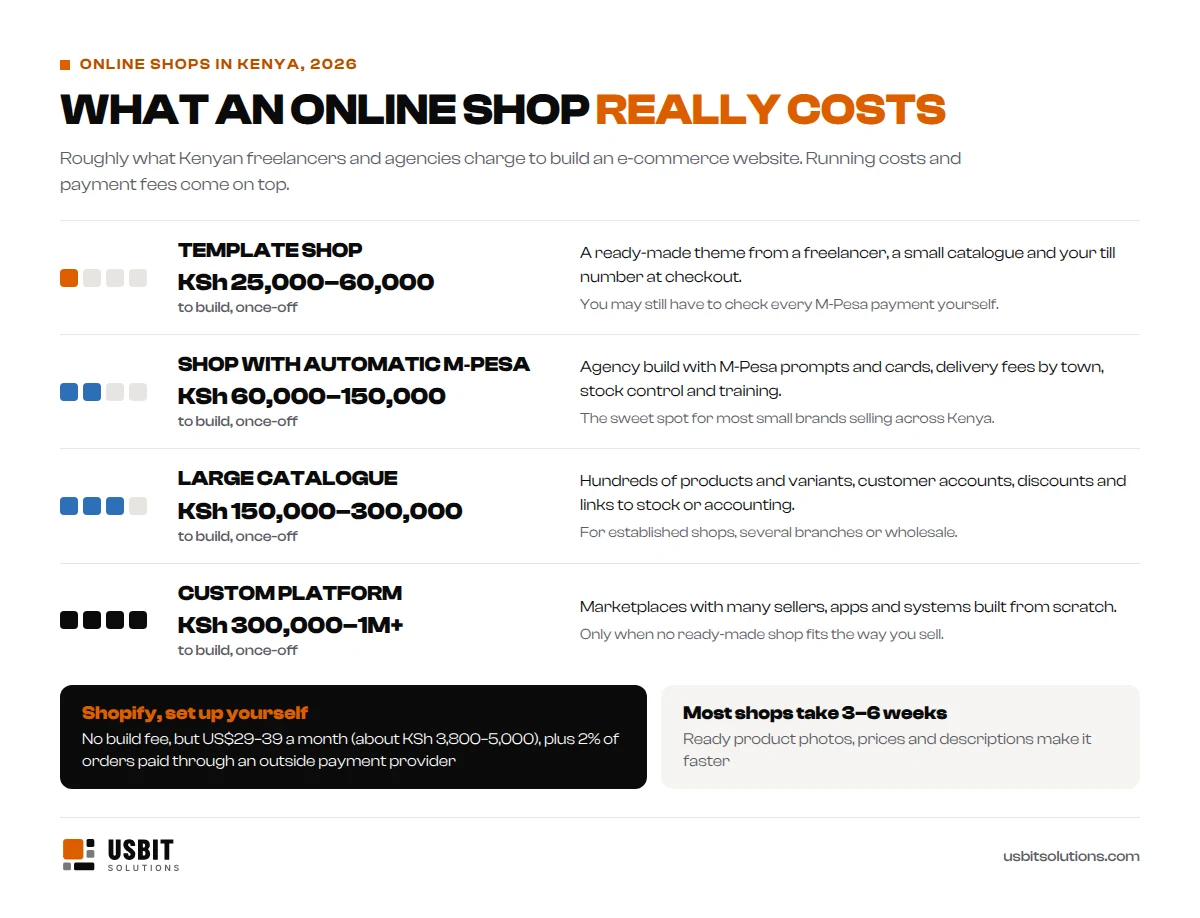
- A basic online shop from a freelancer costs roughly KSh 25,000–60,000, often without automatic M-Pesa.
- A shop with automatic M-Pesa, card payments and delivery zones costs roughly KSh 60,000–150,000 from an agency.
- Large catalogues and shops linked to stock or accounting systems cost KSh 150,000–300,000 or more. Custom platforms can pass KSh 1,000,000.
- Shopify has no build fee if you set it up yourself, but costs US$29–39 a month (about KSh 3,800–5,000), plus 2% of every order paid through an outside payment provider, which is how Kenyan Shopify shops take M-Pesa.
- The build is only part of the bill. Payment fees grow with every sale, and they decide which option is cheapest for you.
What an e-commerce website costs in Kenya in 2026
| Type of shop | Roughly | Suits |
|---|---|---|
| Template shop (freelancer) | KSh 25,000–60,000 | Testing the idea with a small catalogue |
| Shop with automatic M-Pesa (agency) | KSh 60,000–150,000 | Small brands selling across Kenya |
| Large catalogue or integrations | KSh 150,000–300,000+ | Hundreds of products, several branches, stock systems |
| Custom platform or marketplace | KSh 300,000–1,000,000+ | Many sellers, apps, unusual ways of selling |
| Shopify, set up yourself | US$29–39 a month + fees | Starting small, without a developer |
These ranges come from the prices Kenyan freelancers and agencies publish in 2026. Most shops take three to six weeks to build, and the biggest factor is usually how ready your product photos, prices and descriptions are.
What moves the price up or down:
- How many products and variants you sell. Every size, scent or colour needs a photo, a price and its own stock count.
- How customers pay. Showing a till number costs nothing to build. Automatic M-Pesa and card payments take developer time to set up and test properly.
- Delivery. Fees by town or county, pick-up points and couriers outside your own town all need setting up.
- Links to other systems, such as your stock records, accounting software, a shop till or KRA’s eTIMS invoicing.
- Design. A ready-made theme is cheaper than a design made for your brand.
Shopify, WooCommerce or a custom shop?
Most small Kenyan online shops are built on one of three foundations:
- Shopify is rented. Shopify hosts the shop, keeps it secure and updates it, and you pay a monthly plan in dollars. Its own payment system, Shopify Payments, is not available in Kenya, so Kenyan shops take M-Pesa and cards through outside payment providers, and on the Basic plan Shopify adds 2% to those orders. Apps for things like reviews, WhatsApp buttons or delivery often add monthly fees of their own.
- WooCommerce is owned. It is a free plugin that turns a WordPress website into a shop. You own the site and can connect M-Pesa directly to your till through Safaricom, with no middleman fee. In return, you pay for hosting and for someone to keep the shop updated and secure.
- A custom shop is built from scratch for your business. It makes sense for marketplaces, very large catalogues or unusual ways of selling, but it costs the most to build and to change.
For most small brands, the real choice is between the first two: rent a shop on Shopify, or own one on WooCommerce. Neither is always cheaper. It depends on how much you sell, as Chebet found out.
The running costs nobody quotes
A quote covers the build. These costs come every month or every year after it:
| Cost | Roughly |
|---|---|
| .co.ke domain | KSh 1,200–2,500 a year to renew |
| Hosting (your own shop) | KSh 5,000–10,000 a year for a small shop; KSh 10,000–60,000 a year on a VPS for a busy one |
| Shopify plan | US$29–39 a month (about KSh 3,800–5,000) |
| Maintenance (your own shop) | KSh 10,000–20,000+ a month for an online shop |
| Payment fees | From 0.55% to about 4.5% of each order (see below) |
| Apps and plugins | Free to a few thousand shillings a month |
| Delivery | Per order, usually added to the customer’s total |
Our guides to hosting costs and website maintenance costs go into the first few in detail. And budget for product photos. On an online shop, they do most of the selling. A phone, a big window and a plain white background are a good start, with a professional shoot for your best sellers.
Payment fees: the cost that grows with every sale
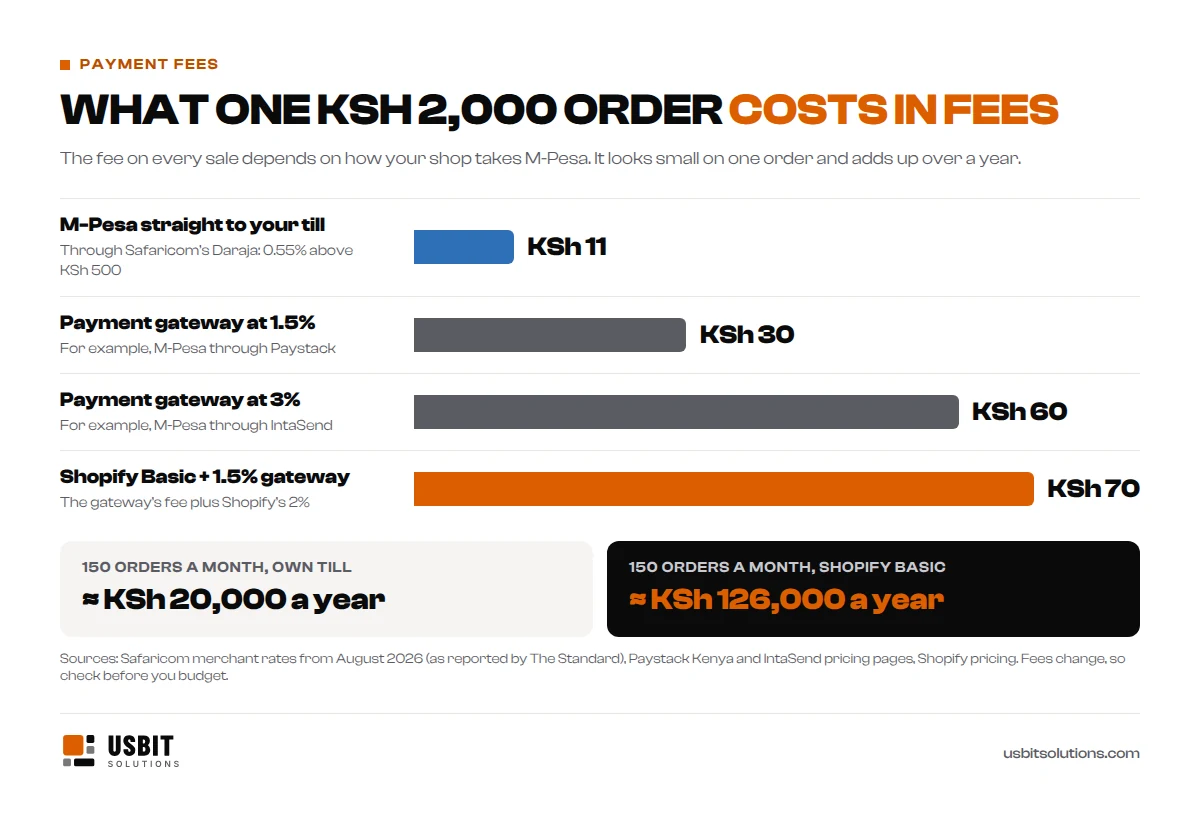
Every online payment costs something. On a KSh 2,000 order:
- Straight to your till, through Safaricom’s Daraja connection: Buy Goods payments are free for the business up to KSh 500, then 0.55%, capped at KSh 200, under Safaricom’s rates from August 2026. That is about KSh 11.
- Through a payment gateway: Paystack’s Kenyan pricing is 1.5% for M-Pesa, 2.9% for local cards and 3.8% for international cards. IntaSend lists 3% for M-Pesa and 3.5% for local cards. That is KSh 30–60 for M-Pesa on the same order.
- On Shopify Basic: the gateway’s fee plus Shopify’s 2%. About KSh 70, even at the lowest gateway rate.
KSh 70 against KSh 11 does not sound like much. On 150 orders a month, it is the difference between about KSh 20,000 and KSh 126,000 a year. Fees do change, so check each provider’s current pricing before you decide.
Chebet’s maths: Shopify or her own shop?
Chebet put her own numbers into a simple comparison: 150 orders a month at KSh 2,000, all paid by M-Pesa.
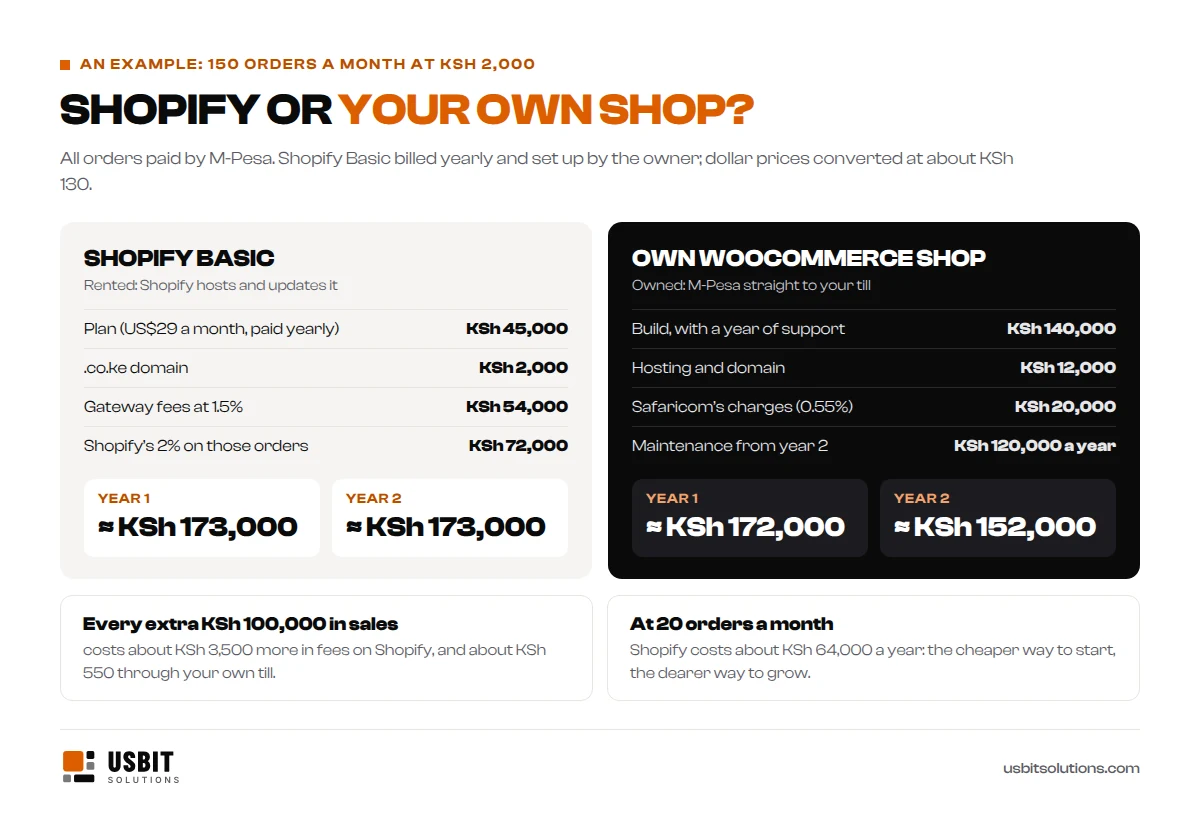
Shopify, on the Basic plan paid yearly and set up herself: about KSh 45,000 for the plan, KSh 2,000 for her .co.ke domain, KSh 54,000 in gateway fees at 1.5% and KSh 72,000 in Shopify’s 2%. About KSh 173,000 a year, every year, and more as sales grow.
Her own WooCommerce shop, with M-Pesa straight to her till: KSh 140,000 to build, including a year of support, KSh 12,000 for hosting and the domain, and about KSh 20,000 in Safaricom’s charges. About KSh 172,000 in the first year. From the second year, with maintenance at KSh 10,000 a month, about KSh 152,000.
In the first year, the two cost almost exactly the same. After that, her own shop is cheaper, and the gap grows with every order: each extra KSh 100,000 in sales costs about KSh 3,500 more in fees on Shopify, and about KSh 550 through her own till.
The maths runs the other way for a smaller shop. At 20 orders a month, Shopify would cost about KSh 64,000 a year, far less than building her own. That is the honest answer to the Shopify question: it is the cheaper way to start, and the more expensive way to grow.
And the KSh 25,000 shop? It was the cheapest by far, but it left her checking every M-Pesa message by hand, which was exactly the problem she was trying to solve.
What every Kenyan online shop needs
- Automatic M-Pesa (STK Push), so orders are marked paid without screenshots. Card payments too, if you sell to customers abroad. Our guide on how to add M-Pesa to your website explains the options.
- A checkout built for phones. Most of your customers will order on one.
- Delivery fees by town or area, shown before payment, with pick-up points if you use them.
- Stock control, so nobody can buy what you have run out of.
- Order messages by SMS, WhatsApp or email, for you and for the customer.
- A privacy policy and a returns policy. An online shop collects names, phone numbers and addresses, so Kenya’s Data Protection Act applies.
- Good photos and honest descriptions, including sizes, ingredients and delivery times.
- Google Analytics and Search Console, so you know where your buyers come from.
Questions to ask before you pay a deposit
- Will M-Pesa payments be confirmed automatically, or will I check them myself?
- Who owns the website, the domain and the customer list if we stop working together? Will I have every login?
- What are all the running costs: hosting, apps or plugins, maintenance and payment fees?
- How many products will you add, and who takes the photos and writes the descriptions?
- How will delivery fees work for customers outside my town?
- What happens when something breaks on a Saturday night during a sale?
For more on comparing quotes, read how much a website costs in Kenya.
Chebet’s shop, three months later
Chebet chose her own shop, with M-Pesa connected straight to her till. Her sales already justified it, and she wanted the customer list to be hers.
The build took five weeks, most of it spent photographing forty products by the big window in her workroom and writing down exactly what goes into each jar.

Customers now choose, pay with an M-Pesa prompt and see the delivery fee for their town before they pay. Each order arrives already marked paid, with the address. Her evening admin has dropped from three hours to about forty minutes, most of it packing. Orders have grown from about 150 to 190 a month, many of them placed late at night by customers who would once have given up waiting for a reply.
She still answers WhatsApp. But most messages now say “Ordered!”, not “Price?”.
One more thing went on her list: if her yearly sales pass KSh 5 million, she will need to register with the Data Protection Commissioner.
Chebet is a composite of the business owners we work with. The build prices are typical ranges, not quotes. Shopify’s prices and fees come from Shopify, the gateway fees from Paystack and IntaSend, and Safaricom’s charges from its August 2026 tariff as reported by The Standard.
Want an online shop that pays for itself?
Our E-commerce website package is KSh 120,000 once-off, or KSh 12,999 a month plus KSh 16,999 setup. It includes the full shop setup, M-Pesa and secure card payments, stock management, customer accounts, SEO and 12 months of support. We test real payments before launch, and you own the website, the domain and every customer record. Our prices include VAT.
See how we build shops on our web design page, or compare every package on our pricing page. Once your shop is live, read what Facebook ads cost in Kenya to bring in your first buyers.
E-commerce websites in Kenya: FAQs
How much does an e-commerce website cost in Kenya?
Roughly KSh 25,000–60,000 for a basic template shop from a freelancer, KSh 60,000–150,000 for a shop with automatic M-Pesa and card payments from an agency, and KSh 150,000–300,000 or more for large catalogues or shops linked to other systems. Shopify has no build fee if you set it up yourself, but costs US$29–39 a month plus fees.
Can I use Shopify in Kenya?
Yes. You pay the plan in US dollars, and because Shopify Payments is not available in Kenya, you take M-Pesa and cards through an outside payment provider. On the Basic plan, Shopify charges 2% on those orders, on top of the provider’s own fee.
Is Shopify cheaper than building my own shop?
At first, usually yes. But because Shopify adds a percentage to every order, it gets more expensive as sales grow. In our example, a shop with 150 orders a month cost about the same either way in the first year, and less on its own from the second year.
Is WooCommerce free?
The plugin is free. You pay for hosting, a domain, any premium plugins, the setup work and ongoing maintenance.
How much are payment fees for an online shop in Kenya?
M-Pesa payments straight to your till are free for the business up to KSh 500, then 0.55%, capped at KSh 200. Payment gateways charge about 1.5–3.5%, and international cards up to about 4.5%. On Shopify’s Basic plan, add 2%.
Can my online shop take M-Pesa automatically?
Yes, through STK Push: the customer gets a PIN prompt on their phone and the order is marked paid automatically. For a direct connection you need a registered business and a Till or Paybill in the same name.
How long does it take to build an online shop?
Usually three to six weeks. The biggest factor is how ready your product photos, prices and descriptions are.
How much does it cost to run an online shop each month?
For your own shop: hosting and a domain from roughly KSh 6,000 a year, maintenance of roughly KSh 10,000–20,000 a month, and payment fees on each order. On Shopify: the plan, any apps and the payment fees, including Shopify’s 2%.
Should I sell on Jumia or build my own shop?
Marketplaces bring ready buyers, but they take a commission on each sale and keep the customer relationship. Your own shop costs more to start, but the customers, the data and the margin are yours. Many brands use both.