At eleven o’clock on a Saturday, the best hour of the week for a café, Njambi counted the tables. Six of twenty were taken.
Two doors down, the new place had a queue on the pavement. Through the window she could see young people holding their phones over stacks of pancakes, filming before they ate.
Njambi had run her café in Westlands for five years. Her coffee was better, and her regulars said so. But when she opened her own Instagram page, the last post was seven weeks old: a slightly blurry cappuccino. Her niece used to post “when she had time”, for KSh 5,000 a month, until she went back to university.
That week, Njambi asked three agencies for a quote. They came back as:
- KSh 18,000 a month: Instagram and Facebook, 12 designed posts, captions and scheduling. “Just send us your photos.”
- KSh 45,000 a month: Instagram, TikTok and Facebook, 16 posts including 8 short videos, a half-day shoot at the café every month, replies to comments and messages, and a monthly report. Three-month minimum.
- KSh 130,000 a month: everything in the second, plus ads management, two creator visits a month and weekly reports. “Ad budget not included.”
Three prices, three very different promises, and no way to tell which one she actually needed. Her question is the one many Kenyan business owners type into Google: “What should a social media marketing package include, and what should it cost?”
The short answer
- In Kenya in 2026, managing your social media costs roughly KSh 15,000–25,000 a month for a basic package, KSh 25,000–60,000 for what most small businesses need, and KSh 60,000–150,000 or more for full service.
- A good package covers the platforms, a set number of posts and videos, content creation, scheduling, replies to comments and messages and a monthly report.
- Your ad budget is almost always paid separately. Shoots, influencer fees and VAT sometimes are too.
- Compare packages by what they produce and who does the work, not by how many posts they promise.
What a social media package actually includes
“Social media management” can mean anything from someone posting your photos twice a week to a team planning, filming, posting, replying and running ads. When you compare quotes, look for these parts:
- Strategy: who you are trying to reach, on which platforms, and what you want them to do.
- Content creation: graphics, photos, short videos (reels and TikToks) and captions. This is where most of the cost, and most of the difference, sits.
- Posting and scheduling: a calendar you approve, posted at the times your customers are online.
- Community management: replying to comments and direct messages, and spotting complaints early.
- Reporting: what happened last month and what changes next month.
- Ads management (in some packages): planning and running paid campaigns. The ad budget itself is extra.
Social media marketing prices in Kenya, 2026

| Level | Roughly, a month | Usually includes |
|---|---|---|
| Basic | KSh 15,000–25,000 | 1–2 platforms, 8–12 posts, graphics from your photos, scheduling, short report |
| Standard | KSh 25,000–60,000 | 2–3 platforms, 12–20 posts with short videos, a content shoot, replies to messages, monthly report |
| Full service | KSh 60,000–150,000+ | 3–4 platforms, 20–30+ posts, regular video, ads management, creator coordination, weekly reports |
These ranges come from published price lists of Kenyan agencies in 2026. Freelancers often charge less, and big agencies serving corporates charge much more.
Njambi’s three quotes now made sense. The KSh 18,000 one was a basic package that depended on her own photos, which she did not have. The KSh 130,000 one was full service, built for a business already spending on ads. The KSh 45,000 one sat in the middle, and it included the thing she was missing most: someone to come and film the café.
Which platforms matter in Kenya?
You do not need to be everywhere. You need to be where your customers are, and be good there.
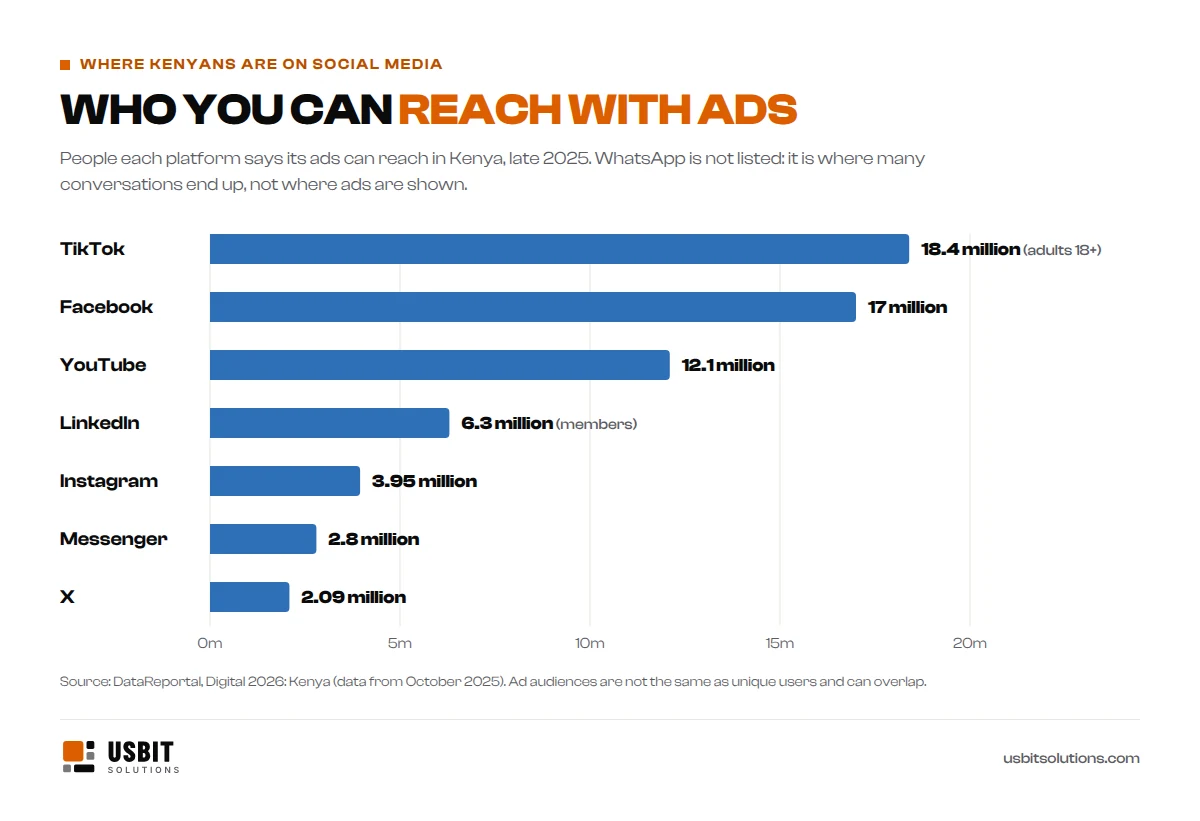
According to DataReportal’s Digital 2026 report for Kenya, there were 18.4 million social media user identities in the country in late 2025. The platforms’ own ad tools suggest where to find them:
- TikTok and Facebook reach the most people, with ad audiences of 18.4 million adults and 17.0 million. TikTok suits food, fashion, beauty, events and anything that looks good on video. Facebook is strong for local communities, groups and older customers.
- YouTube (12.1 million) suits longer videos: how-tos, reviews and product demos.
- LinkedIn (6.3 million members) is the place for business-to-business services, professional firms and recruitment.
- Instagram (3.95 million) is smaller, but it is where many customers browse cafés, fashion, beauty and interiors before they visit.
- WhatsApp is where many Kenyan sales actually close. Make it easy to move from a post to a chat. Our guide to Facebook ads in Kenya covers ads that open a WhatsApp chat.
For Njambi, the answer was Instagram and TikTok for brunch and coffee, with Facebook for her older regulars and events.
What is usually not included
This is where two packages that look the same on paper turn out very different on the invoice.
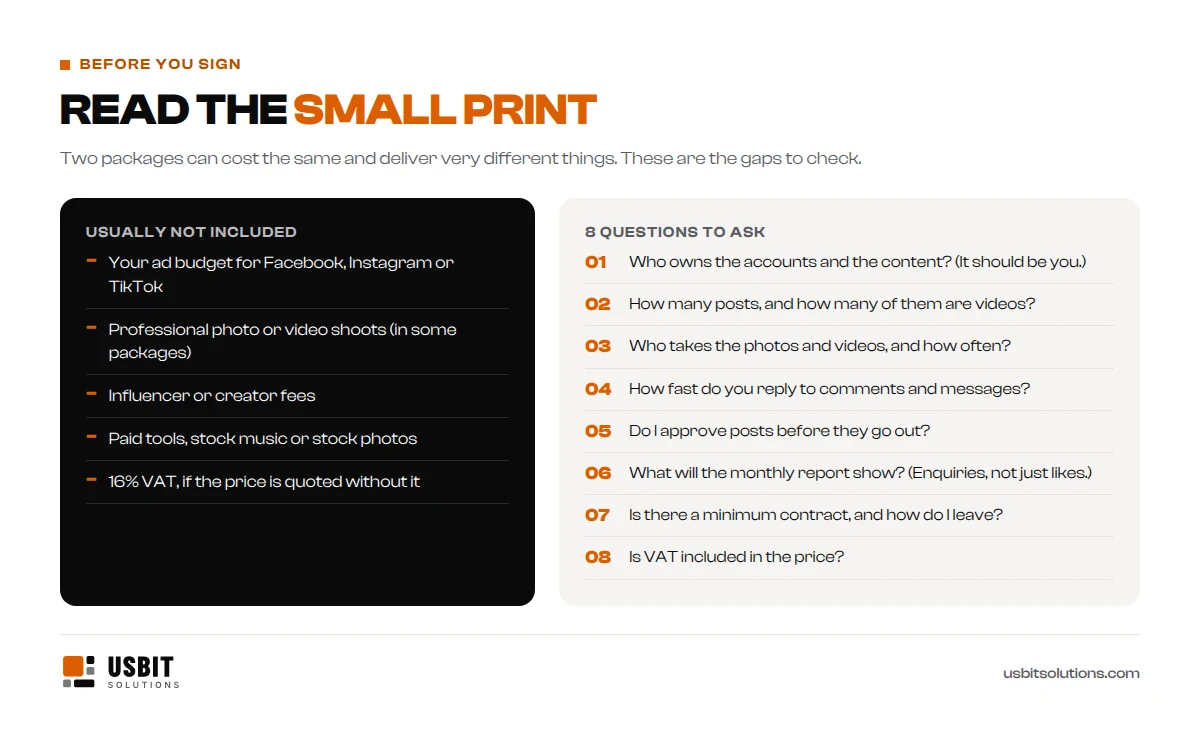
- Your ad budget. A package might include “ads management”, which is the work of running ads. The money Meta or TikTok charges for showing them is extra.
- Photo and video shoots. Some packages only design graphics from your photos. If you do not have good photos, that is a problem.
- Influencer and creator fees. Paid separately, and they vary a lot.
- Tools, stock music and stock photos. Usually covered by the agency, but worth asking.
- VAT. Some quotes include 16% VAT; others add it on top.
Who owns your accounts?
You should. Your Facebook Page, Instagram and TikTok accounts should be in your business’s name, with your email address and your phone number. Give an agency access as a partner or admin, through Meta Business Suite for Facebook and Instagram, rather than handing over your passwords. If you part ways, you remove their access and keep everything you have built, including the photos and videos you paid for.
Freelancer, agency or in-house?
| Option | Good for | Watch out for |
|---|---|---|
| Freelancer | Small budgets and simple needs. Often flexible and personal. | Everything depends on one person: holidays, illness, other clients. Ask who films and who runs ads. |
| Agency | A team with different skills: content, video, ads and reporting. | Costs more. Ask who will actually work on your account. |
| In-house | Businesses with lots to post every day, who want someone on site. | A salary, phone, tools and training, and nobody to cover when they leave. |
Many small businesses mix them: a staff member films everyday moments on a phone, and an agency turns them into a plan, edits, posts and reports.
What results to expect, and what to measure
The first month is mostly set-up: a plan, a first shoot, a content calendar. Give any package about three months before you judge it.
When you do judge it, look past likes and followers. They are nice, but they do not pay rent. Ask for the numbers that touch your business:
- Messages and WhatsApp chats that started from social media.
- Calls, bookings, orders or website visits from each platform.
- Which posts led to enquiries, so you can make more of those.
- If you run ads: what each enquiry or sale cost.
Njambi’s choice
Njambi chose the KSh 45,000 package, and added KSh 15,000 a month of ads on Instagram and TikTok, shown to people within a few kilometres of the café. She kept the accounts in her own name and added the agency through Meta Business Suite.
The first shoot was a Tuesday morning: the brunch stack, latte art, and her head barista laughing at the espresso machine. That video, twelve seconds long, became the most-watched thing the café had ever posted.

By the third month, the monthly report showed more than a hundred WhatsApp brunch bookings that started on Instagram or TikTok. Saturday at eleven o’clock now has a waiting list.
Njambi still posts the odd cappuccino herself. It is a lot less blurry.
Njambi is a composite of the business owners we work with. The prices are typical ranges, not quotes; the platform figures come from DataReportal.
Want help with your social media?
Our social media management package costs KSh 25,000 a month and covers two platforms and 12 posts a month, with content creation and scheduling, replies to comments and messages, performance reporting and a monthly strategy review. Need ads and tracking as well? Digital Marketing Pro, from KSh 55,000 a month, adds a third platform, Google Ads management, email marketing and conversion tracking. Our prices include VAT. Compare every package on our pricing page, or tell us about your business.
New look needed first? Our branding team can create a social media kit of profile images, covers and post templates. And if customers find you on Google Maps, set up your Google Business Profile too.
Social media marketing in Kenya: FAQs
How much does social media management cost in Kenya?
Roughly KSh 15,000–25,000 a month for a basic package, KSh 25,000–60,000 for most small businesses, and KSh 60,000–150,000 or more for full service with video and ads management. Freelancers can be cheaper; large agencies cost more.
Is the ad budget included in a social media package?
Almost never. “Ads management” is the work of running the ads. The budget Facebook, Instagram or TikTok charges to show them is paid separately, plus VAT.
How many posts a week does my business need?
For most small businesses, three to five good posts a week is plenty, with at least one or two short videos. Posting regularly matters more than posting a lot.
Which social media platform is best for my business in Kenya?
It depends on your customers. TikTok and Instagram suit food, fashion, beauty and events; Facebook suits local communities and older customers; LinkedIn suits business services. Start with one or two and do them well.
Should I hire a freelancer or an agency?
A freelancer can work well for a small budget and simple needs. An agency brings a team for content, video, ads and reporting. Either way, ask who does the work and who owns the accounts.
How long before social media marketing shows results?
Expect the first month to be set-up and the second and third to build momentum. Judge a package after about three months, on enquiries and sales, not only likes.
Who should own my business’s social media accounts?
Your business should. Keep the accounts in your name and give your agency or freelancer access as a partner or admin, never your passwords, so you keep everything if you change providers.
Do social media packages include VAT?
Some do and some do not, so always ask. VAT-registered agencies charge 16%. Our own prices include VAT.