The trade fair in Nairobi had gone better than Mutua expected. By the second afternoon, people were coming back to his stand to buy a second jar.
Then a buyer from a Nairobi supermarket chain tasted his honey, nodded slowly, and picked up the jar.
“The honey is excellent. The label looks homemade.”
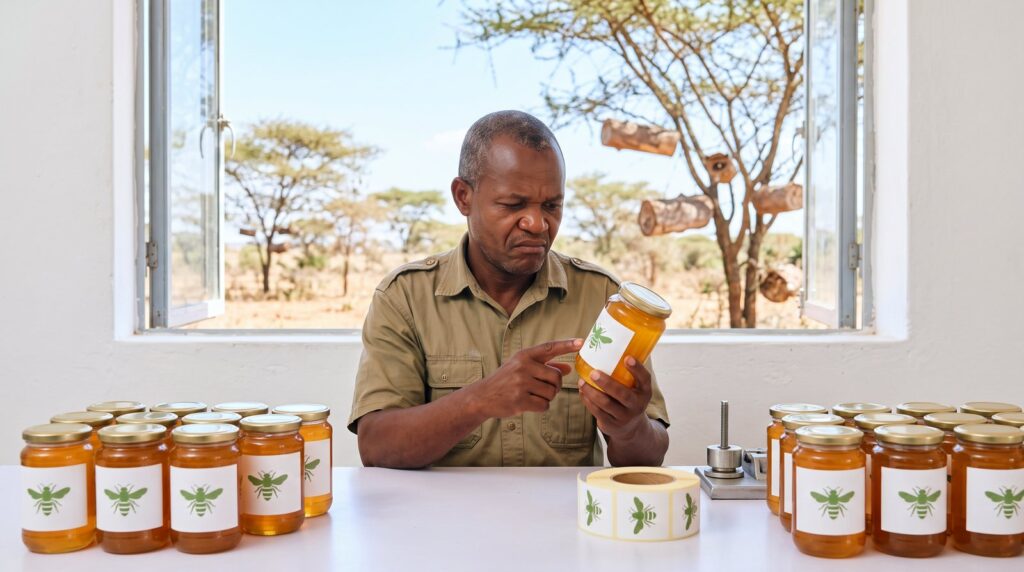
Mutua keeps bees in the dry acacia country outside Kitui town. His honey is thick and golden, and for six years it had sold well at markets, in local shops and to people who already knew him. The label had never seemed important.
He had paid KSh 1,500 for his logo in 2020: a clip-art bee in a green circle, sent to him on WhatsApp as a single small JPG. Every time the printer made the labels bigger, the bee got blurrier. Every print run came out a slightly different green, because nobody had ever written down which green it was.
“Shoppers decide in about three seconds,” the buyer said. “Next to the brands on our shelves, yours looks like it was made at the kitchen table. Bring me a proper label and we’ll talk.”
Back in Kitui, Mutua asked around and got three quotes for a new logo: KSh 3,000, KSh 15,000 and KSh 120,000. Which left him with the question that brings many Kenyan business owners to this page: “Why does one logo cost forty times more than another, and how much should I really pay?”
The short answer
- Logo design in Kenya costs roughly KSh 500–5,000 for a template or app, KSh 5,000–20,000 from a freelance designer, KSh 20,000–50,000 from a senior designer or studio, and KSh 50,000–200,000 or more for a full brand identity from an agency.
- The price reflects research, the number of ideas, revisions, the files you get and who owns the result, not just the picture.
- Whatever you pay, insist on vector files, colour codes and the copyright in writing.
- To protect your logo, register it as a trade mark with KIPI: roughly KSh 12,000 in official fees for one class of goods or services.
What a logo costs in Kenya in 2026

| Who designs it | Roughly | What you usually get |
|---|---|---|
| Template or app | KSh 500–5,000 | A stock icon with your name, often a single image file |
| Freelance designer | KSh 5,000–20,000 | A custom logo, 2–3 ideas, a few revisions, proper files |
| Senior designer or studio | KSh 20,000–50,000 | Research, several directions, a full file pack and a usage guide |
| Agency brand identity | KSh 50,000–200,000+ | Strategy, logo, colours, fonts, stationery, packaging and guidelines |
These ranges come from what Kenyan designers and agencies publish in 2026. Mutua’s three quotes fitted neatly: KSh 3,000 for a logo from an app, KSh 15,000 from a freelance designer, and KSh 120,000 from an agency that would also design his labels, a gift box and a brand guide.
Why logo prices are so different
A logo takes minutes to draw and days to get right. What you are really paying for:
- Research. A good designer looks at your customers, your competitors and where the logo will appear before drawing anything. Mutua’s honey would sit next to imported brands on a supermarket shelf, so it had to stand out from three metres away.
- Ideas and revisions. One idea with no changes is cheap. Three to five ideas, refined over several rounds, takes days.
- Originality. A template uses an icon thousands of other businesses can use too. A custom logo is drawn for you.
- The files. A proper file pack takes real time to prepare, and it is what makes the logo usable for years.
- Everything around the logo. Colours, fonts, labels, signage and guidelines turn a logo into a brand identity, and that is where the higher prices come from.
Mutua realised his KSh 1,500 logo had been cheap because it skipped every one of these. He did not need the agency’s gift box yet. He did need a logo that was his, that printed sharply, and that came out the same colour every time.
The files you should get with your logo
Mutua’s old logo was a single small JPG. That is why it went blurry: a JPG is made of tiny dots, and stretching it to fit a bigger label just makes the dots bigger. A professional logo is drawn as a vector file, which can be printed on a pen or a billboard and stay perfectly sharp.
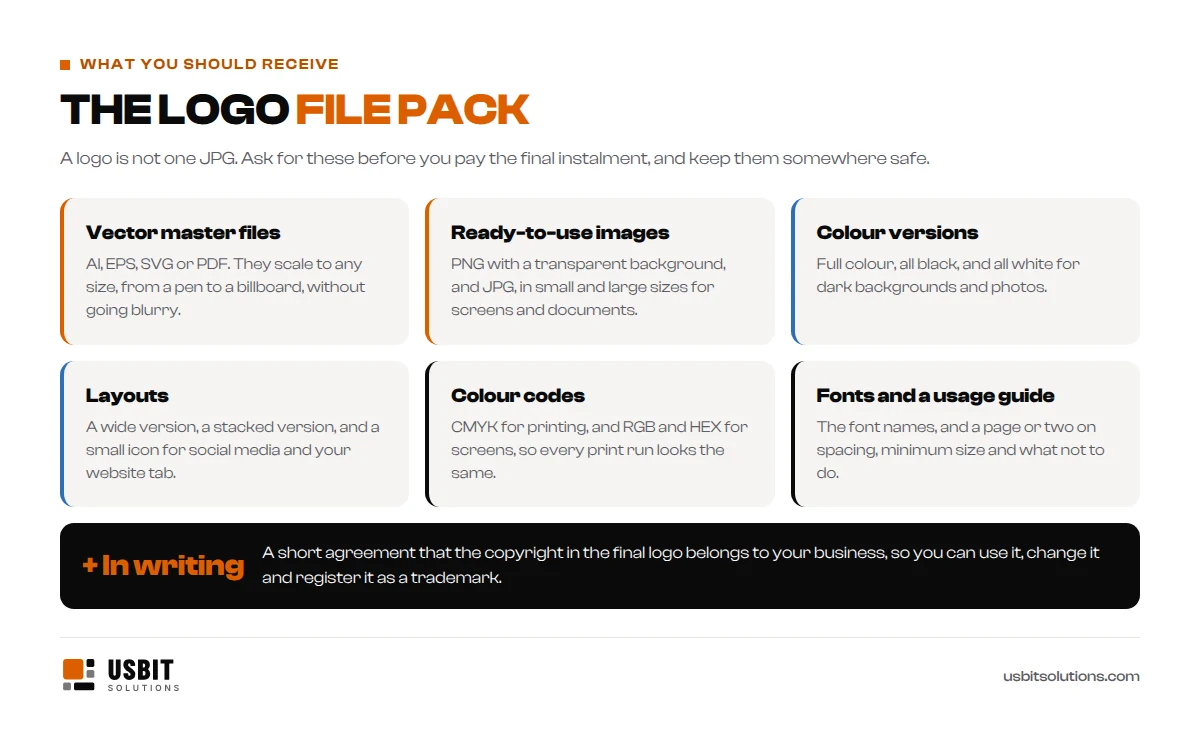
The colour codes matter more than most people think. A CMYK code tells every printer exactly which colour to mix. Without one, each printer guesses, which is why Mutua’s green kept changing.
Keep the files in at least two places, such as your email and a cloud folder. Many Kenyan businesses lose their logo when the designer changes phone numbers, and end up paying to have it redrawn.
Who owns your logo?
Under section 31 of Kenya’s Copyright Act, when you commission a piece of work, the copyright is generally treated as transferred to you, unless your agreement says otherwise. The catch is that last part. If the designer’s terms keep the rights, or nothing is written down at all, you may struggle to prove the logo is yours when it matters.
So get it in writing. One short paragraph in the quote or contract is enough: the copyright in the final logo belongs to your business, and the designer will not sell or reuse it. Most good designers will agree straight away. Ask them to confirm that the logo is original, too, and not built on someone else’s artwork.
The written agreement is also what lets you register the logo as a trade mark later.
Free logo makers and templates
A logo app is fine when you are testing an idea, selling at a weekend market or need something on the signboard by Friday. It becomes a problem when the business grows:
- It is not unique. The same icon may already be on a hundred other businesses, some of them in your town.
- It is hard to protect. You cannot stop others using stock artwork, and many apps’ licences do not let you register a logo built from their icons as a trade mark. Check the licence before you rely on it.
- The files are often limited. Some apps only give you a small image unless you pay more.
Mutua’s clip-art bee was exactly this. When he looked closely at a market in Machakos, he found the same bee on a jar of somebody else’s honey.
Protecting your logo: registering a trade mark in Kenya
Copyright protects the artwork. A registered trade mark goes further: it gives you the right to stop others using your logo, or one confusingly similar, on the same kind of goods or services. In Kenya, trade marks are registered with the Kenya Industrial Property Institute (KIPI).

Trade marks are registered by class, depending on what you sell. Honey falls in class 30, so Mutua needed just one class. Each extra class adds a smaller fee at every stage. You can apply yourself or use a trade mark agent or lawyer, who will charge for their time on top of the KIPI fees.
Start with the preliminary advice, before you print thousands of labels. It tells you whether your mark can be registered and whether something similar already exists, which is far cheaper to discover before launch than after.
How to brief a logo designer
A clear brief gets you a better logo and fewer revisions, whatever you pay. Tell the designer:
- What you sell and who buys it. “Raw honey from Kitui, sold to families in Nairobi supermarkets” is far more useful than “honey”.
- Where the logo will appear. Labels, a shop sign, a delivery bike, Instagram, your website.
- Who you compete with, and what you want to look like next to them.
- What you like and dislike, with a few examples of logos that feel right.
- Your budget and deadline, and the files and rights you expect at the end.
Then judge the designer on their past work, not their price. Ask to see logos they designed for real businesses, not just practice pieces.
Mutua’s honey, a year later
Mutua did not take the cheapest quote or the most expensive one. He chose the freelance designer, at KSh 15,000, after seeing her work for two other food brands. He paid her a little extra to lay out the new label, and asked for everything on the file pack list, with the copyright in writing.
The new logo is an orange hexagon, like a honeycomb cell, with an acacia tree inside it: his honey, from his part of Kenya. The printer has the CMYK codes, so every batch of labels comes out the same orange. And for roughly KSh 12,000 in KIPI fees, he registered it as a trade mark.

When he went back to the buyer with the new jars, she placed a trial order for two Nairobi branches. The reorder came three weeks later. The honey had not changed at all.
Mutua is a composite of the business owners we work with. The costs are typical ranges, not quotes; the trade mark fees come from KIPI’s published fee schedule and the ownership rules from Kenya’s Copyright Act.
Want a logo that works as hard as your product?
Basic logo design with us costs KSh 15,000: three custom concepts, two revisions on the one you choose, vector files, colour and black-and-white versions and a basic usage guide, in 7 days. A Professional brand identity, at KSh 45,000, gives you five concepts and a complete identity system with your colour palette, fonts, business card and basic guidelines, in 14 days. A Corporate brand identity, at KSh 85,000, adds brand strategy, a detailed guidelines manual and a full stationery suite, in 21 days. Packaging and labels are quoted individually, and our prices include VAT.
See the packages on our branding page, compare everything on our pricing page, or tell us about your business. Once you have a logo you are proud of, put it to work: read how to set up your Google Business Profile and what social media marketing packages include.
Logo design in Kenya: FAQs
How much does a logo cost in Kenya?
Roughly KSh 500–5,000 for a template or app, KSh 5,000–20,000 from a freelance designer, KSh 20,000–50,000 from a senior designer or studio, and KSh 50,000–200,000 or more for a full brand identity from an agency.
Why do logo design prices vary so much?
Because you are paying for research, the number of ideas and revisions, the files you receive, who owns the result and how much is designed around the logo, such as colours, fonts, packaging and guidelines.
What files should I get from my logo designer?
Vector master files (AI, EPS, SVG or PDF), PNG and JPG images, versions in full colour, all black and all white, wide, stacked and icon layouts, CMYK, RGB and HEX colour codes, the font names and a short usage guide.
Who owns the copyright in my logo?
Under Kenya’s Copyright Act, the copyright in a commissioned work is generally treated as transferred to the person who commissioned it, unless the agreement says otherwise. To be safe, get a written statement that the copyright in the final logo belongs to your business.
Is a free logo maker good enough?
For testing an idea, yes. For a growing business, usually not: the icons are not unique, other businesses may use the same ones, and many apps’ licences do not let you register the result as a trade mark.
How long does logo design take?
Usually one to three weeks, depending on how many concepts and revisions are included and how quickly you give feedback. A full brand identity can take longer.
How much does it cost to register a trade mark in Kenya?
For applicants in Kenya, KIPI’s official fees for one class come to roughly KSh 12,000: preliminary advice, the application, advertisement and registration. Extra classes cost less each, and agent or lawyer fees are extra. Check kipi.go.ke for current fees.
What is the difference between a logo and a brand identity?
A logo is the mark itself. A brand identity is the full system around it: colours, fonts, how the logo is used, and how it appears on packaging, signage, stationery and social media, usually written up in brand guidelines.
Can I change my logo later?
Yes. Many businesses refresh their logo as they grow, keeping what customers recognise and modernising the rest. If your logo is registered as a trade mark and changes significantly, you may need a new registration.