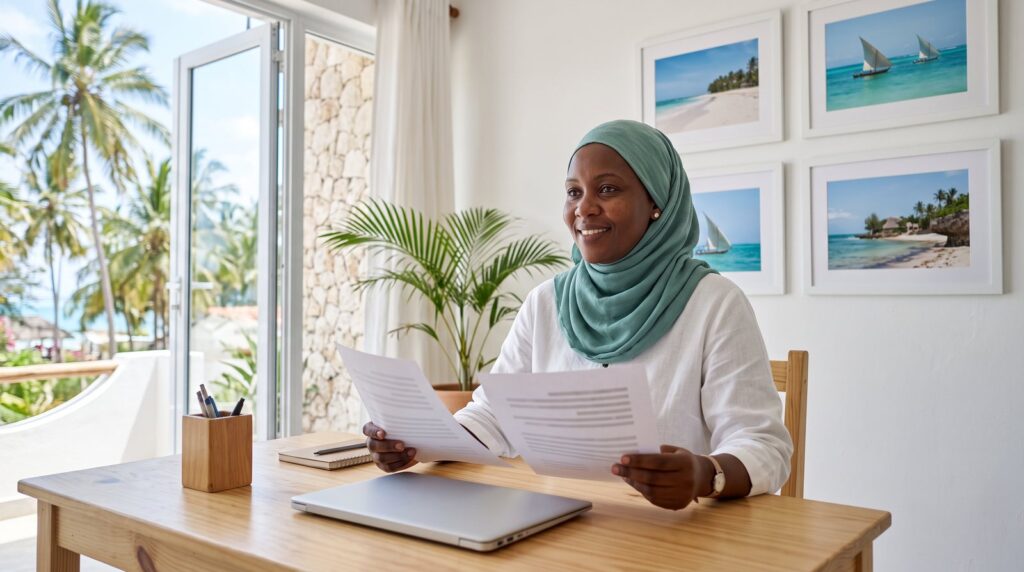
At eight o’clock on a Thursday night, Dr Atieno was still at the reception desk of her dental clinic in Milimani, Kisumu. The last patient had left two hours earlier. She was not doing paperwork. She was fighting a website builder.
It was her third weekend at it, if you counted the evenings. Patients kept asking, “Do you have a website?” An insurer’s provider list wanted her web address. A man in Nairobi had phoned to ask what she charged for whitening before he came home for Christmas, and she realised she had nowhere to send him.
So she had picked a template with a smiling model and a lot of blue. On the first weekend she chose colours. On the second she typed “Welcome to our website” and stopped. On the third she built a booking form that asked patients for their full medical history, then wondered whether she was allowed to do that. And when she finally opened the site on her phone, the menu covered half the screen.
She closed the laptop and typed the question that brings a lot of Kenyan business owners to this page: “How do you actually create a website for a business, and what do you do first?”
The short answer
- Decide the website’s one job: calls, bookings, enquiries or sales.
- Register a domain and hosting in your business’s name.
- Choose how to build it: a website builder or WordPress yourself (roughly KSh 3,000–15,000 in the first year, plus your time), or a designer (roughly KSh 40,000–150,000 for a professional small business site).
- Plan five to seven pages, write them in plain words and use real photos.
- Design for phones first, with call and WhatsApp buttons, HTTPS and a privacy policy.
- Connect it to Google, test everything on a phone, launch, and keep it updated.
A small business website usually takes two to six weeks from start to launch.
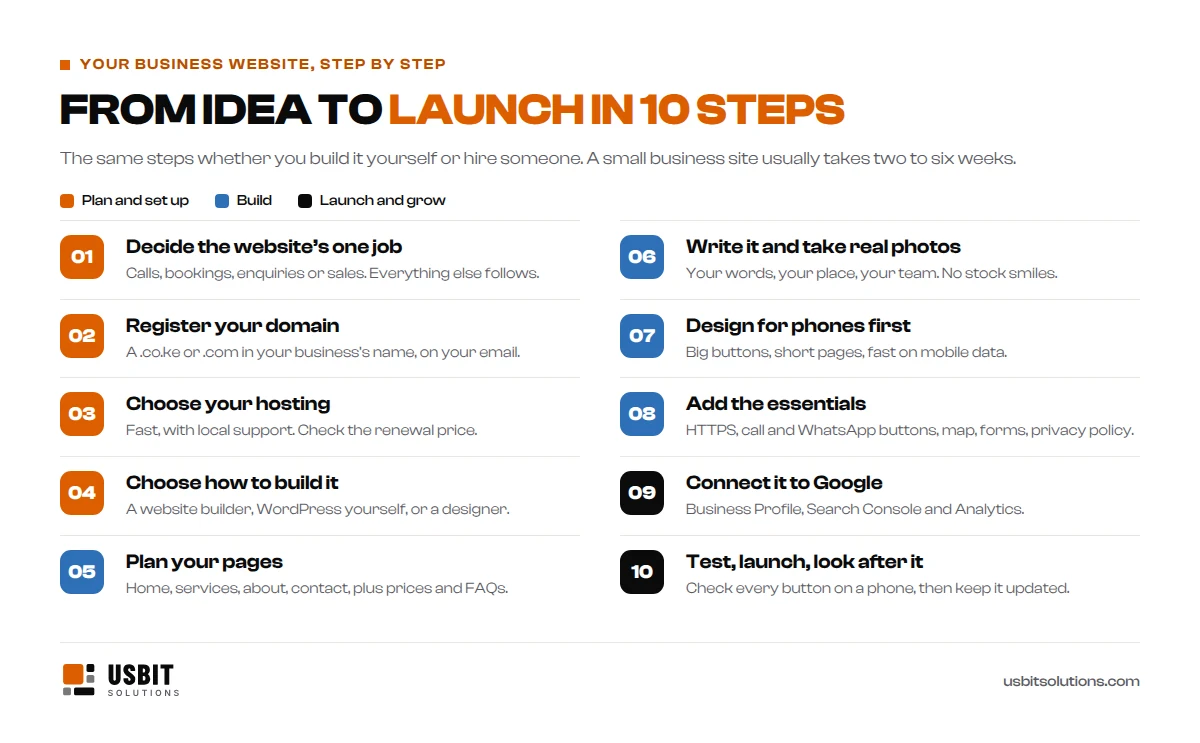
Step 1: Decide what your website must do
Most business websites fail quietly because nobody decided what they were for. Before colours, templates or logos, answer one question: if a visitor does one thing, what should it be?
For a restaurant it might be a table booking. For a hardware shop, a call. For an online shop, a sale. For Dr Atieno, it was simple once she wrote it down: book a check-up on WhatsApp. Everything else on the website, from the prices to the photos, was there to make that one tap feel safe.
Step 2: Register your domain
Your domain is your address online, such as yourbusiness.co.ke. Keep it short, easy to spell and close to your business name. A .co.ke tells visitors you are a Kenyan business; a .com works well if you also sell abroad. Many businesses register both.
Register it in your business’s name, with an email address you control. Expect to pay roughly KSh 1,000–2,500 a year. Domains ending in .ke are managed by KeNIC and sold through registrars, which include most Kenyan hosting companies.
Step 3: Choose your hosting
Hosting is where your website lives. For most small business websites, a good shared hosting plan is plenty, at roughly KSh 2,000–10,000 a year. Look for fast servers, local support, free SSL and daily backups, and always check the renewal price, not just the first-year offer.
Our guide to what hosting costs in Kenya explains what to ask before you pay. If you use a website builder such as Wix or Shopify, hosting is included in your monthly plan.
Step 4: Choose how to build it
This is the decision that sets your budget and your evenings.
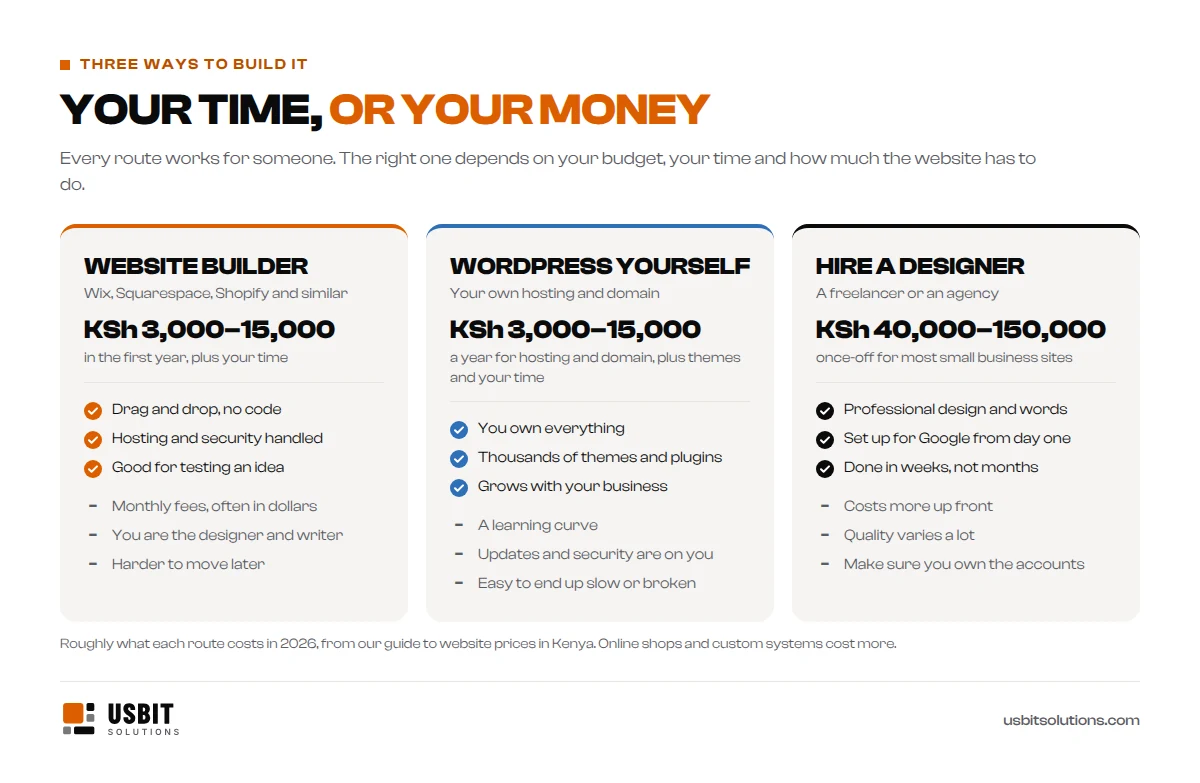
- A website builder (Wix, Squarespace, Shopify and similar) is the quickest way to start. You drag and drop, and hosting and security are handled for you. But you pay monthly, often in dollars, and you are the designer, the writer and the photographer.
- WordPress yourself gives you full ownership and room to grow, for the cost of hosting and a domain. It has a learning curve, and updates and security are your job.
- Hiring a designer or agency costs more up front, but you get professional design and words, a site set up for Google from day one, and your evenings back. Quality varies a lot, so look at their past work.
Dr Atieno did the maths she had been avoiding. Each evening spent on the website was an evening she could have spent with her children, or a Saturday clinic she could have run. She decided to hire, and to use what she had learned to brief the designer properly. If you are weighing up quotes, our guide to how much a website costs in Kenya compares them in detail.
Step 5: Plan your pages
Most small business websites need five to seven pages. Dr Atieno’s plan looked like this:
- Home: who you are, who you help and the one thing you want visitors to do.
- Services: ideally a short page for each main service, such as check-ups, braces, whitening and children’s dentistry. People search for the service, not the clinic.
- Prices: real prices or “from” prices. Nothing builds trust faster.
- About: the team, with real photos and qualifications.
- Payments and insurance: M-Pesa, cards and the insurers you accept.
- Contact and booking: phone, WhatsApp, map, opening hours.
- FAQs: the questions you answer on the phone every day.
Step 6: Write the words and take real photos
Write the way you speak to customers. Answer the questions they actually ask: does it hurt, how long does it take, what does it cost, can I pay with M-Pesa, where do I park? “Welcome to our website” can go.
Use real photos of your premises, your team and your work. Stock photos of models look like every other website and earn no trust. If you show customers or patients, get their written permission first.
Step 7: Design for phones first
Kenya has 77.5 million mobile connections, more than one for every person, according to DataReportal. A large share of your visitors will arrive on a phone, often on mobile data. So design for the small screen first, then make it look good on a laptop:
- A short menu that does not cover the page.
- Big, thumb-friendly buttons to call and to WhatsApp you.
- Short paragraphs and clear headings.
- Compressed images, so pages open quickly. Google’s research found that more than half of mobile visitors leave a page that takes longer than three seconds to load.
Step 8: Add the essentials
- HTTPS (the padlock), from a free SSL certificate on most good hosting.
- Click-to-call and WhatsApp buttons on every page.
- A Google map with your exact location and opening hours.
- A simple contact or booking form that sends to an inbox someone checks.
- Payments, if you sell or take deposits online. Our guide shows how to add M-Pesa to your website.
- A privacy policy that explains what you collect and why.
A word on data protection
This was the question that had stopped Dr Atieno. Under Kenya’s Data Protection Act, health information is sensitive personal data, which needs extra care. The answer was simple: her booking form now asks only for a name, a phone number and a preferred day. Medical history is taken in the clinic, not on a website form.
Some businesses also have to register with the Office of the Data Protection Commissioner. Under the 2021 registration regulations, very small businesses are exempt, but not if they work in certain sectors, including health care, education, hospitality, property, financial services and transport. For a micro or small business, registration costs KSh 4,000. If your website collects personal details, it is worth checking where you stand.
Step 9: Connect your website to Google
- Google Business Profile: link your website from your listing on Google Maps. If you do not have one yet, follow our guide to setting up a Google Business Profile in Kenya.
- Google Search Console: free. Add your website and submit your sitemap, so Google knows every page exists.
- Google Analytics: free. See how many people visit, from where, and what they do.
- Titles and descriptions: give every page a clear title and a one-line description, the text people see in Google’s results.
Step 10: Test, launch and look after it
Before you tell anyone the website is ready, go through it on your own phone, on mobile data, and press every button.
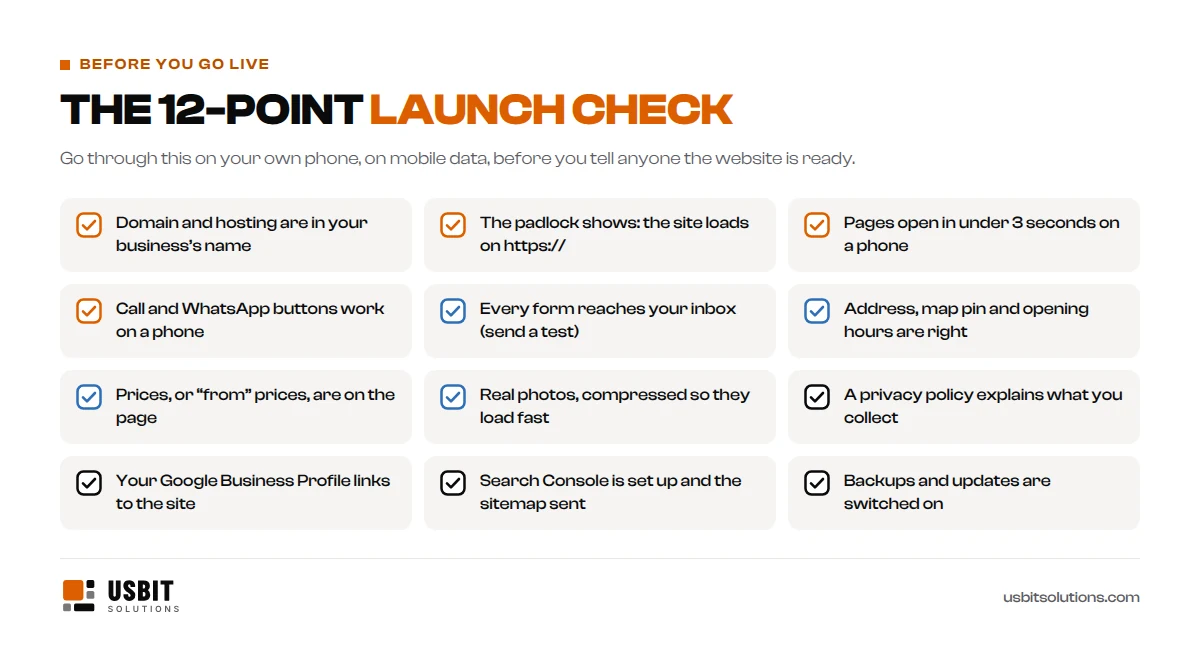
Then look after it. A website is not a signboard you put up once. It needs security updates, backups, a renewed domain and hosting every year, and fresh content now and then. Do it yourself, or have someone do it for you with a care plan.
Dr Atieno’s website, six weeks later
The new website had seven pages, “from” prices for every treatment, photos of her real team and treatment room, and a green WhatsApp button on every page. The booking form asked for three things. She registered the clinic with the Data Protection Commissioner the same week.

In December, the man from Nairobi found the clinic on Google, read the whitening page, saw the price and booked on WhatsApp from his office. When he walked in, he showed the receptionist the chat on his phone and said, “Your website answered all my questions.”
Dr Atieno now spends her Thursday evenings at home.
Dr Atieno is a composite of the business owners we work with. The steps, prices and rules in this guide are real.
Want us to build it with you?
Our Startup website costs KSh 65,000 once-off, or KSh 5,999 a month plus KSh 9,999 setup, and includes custom design, your domain, hosting and email, basic on-site SEO, a contact form and three months of support. The Business website, at KSh 95,000, adds more pages, live chat and Google Analytics. Compare every package on our pricing page, or tell us about your business and we will suggest the right fit.
Creating a business website in Kenya: FAQs
How much does it cost to create a website in Kenya?
Roughly KSh 3,000–15,000 in the first year if you build it yourself, KSh 10,000–50,000 for a simple site from a freelancer, KSh 40,000–150,000 for a professional small business website, and KSh 60,000–300,000 or more for an online shop with M-Pesa.
How long does it take to create a business website?
A small business website usually takes two to six weeks, depending on how quickly the words and photos are ready. Online shops and custom systems take longer.
Can I create a business website for free?
Free plans exist, but they usually show the builder’s adverts and give you an address like yourname.builder.com. For a business, your own domain and hosting cost only a few thousand shillings a year and look far more trustworthy.
Do I need a .co.ke domain?
No, but it tells visitors you are a Kenyan business. A .com works well if you sell abroad. Many businesses register both and point one to the other.
Is WordPress or Wix better for a small business?
Wix is easier to start with and handles hosting for you, for a monthly fee. WordPress takes more learning but you own everything and it grows with you. Many professional designers in Kenya build on WordPress.
What pages should a small business website have?
Usually a home page, services (ideally a page per main service), prices, about, contact, and FAQs. Add a blog later if you will keep it going.
Does my website need a privacy policy?
If it collects personal details, such as through a contact or booking form, yes. Kenya’s Data Protection Act requires you to tell people what you collect, why and how you protect it.
Do I need to register with the Data Protection Commissioner?
Businesses with an annual turnover above KSh 5 million or ten or more employees must register. So must smaller ones in certain sectors, including health care, education, hospitality, property, financial services and transport. Check the Office of the Data Protection Commissioner’s guidance for your case.
How do I get my new website on Google?
Add it to Google Search Console and submit your sitemap, link it from your Google Business Profile, and give every page a clear title and description. Then keep adding useful pages. Our SEO services can help if you want to climb faster.