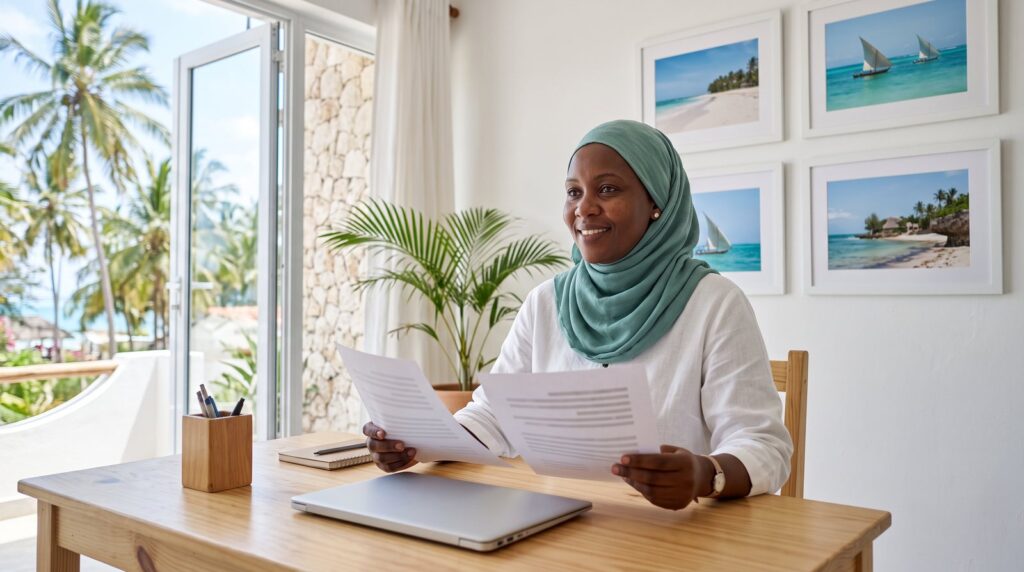
Wanjiku’s phone buzzed three times before the first tray of mandazi came out of the oven.
Three web designers. Three quotes. KSh 15,000. KSh 85,000. KSh 450,000.
She runs a busy little bakery in Kilimani. Orders arrive on WhatsApp and Instagram, regulars keep asking “do you have a website?”, and this was the week she finally decided to get one. Now she was staring at three numbers that made no sense together. Was the first designer a bargain, or were the other two overcharging? Was anyone telling the truth?
If you have ever typed “how much does a website cost in Kenya?” into Google, you have probably had the same morning. So let’s answer it properly, with real numbers, and follow Wanjiku as she works it out.
The short answer (2026)
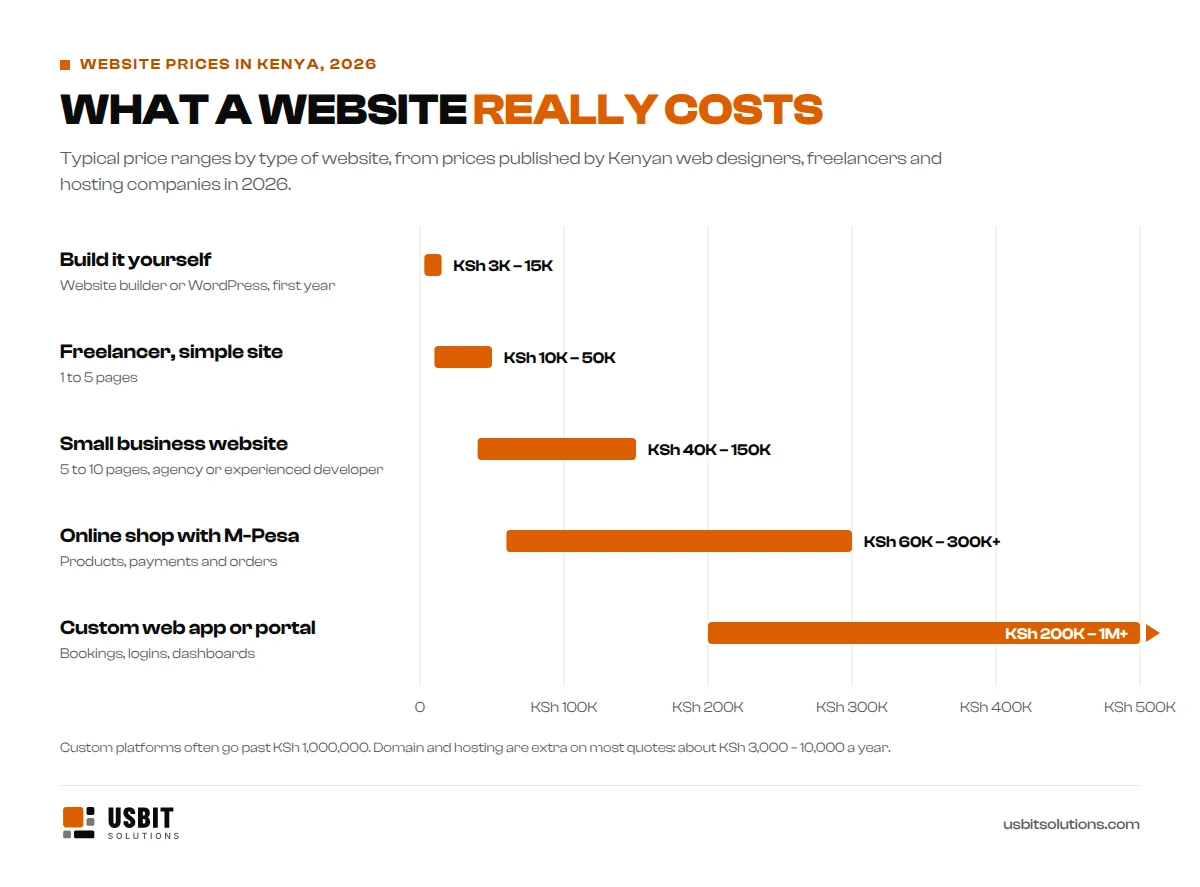
- Build it yourself: about KSh 3,000–15,000 in the first year.
- A simple site from a freelancer: KSh 10,000–50,000.
- A professional small business website: KSh 40,000–150,000.
- An online shop with M-Pesa: KSh 60,000–300,000+.
- A custom web app or portal: KSh 200,000 to over KSh 1,000,000.
On top of that, budget about KSh 3,000–10,000 a year for your domain and hosting, plus something for care after launch.
Website prices in Kenya at a glance (2026)
Before we go back to the bakery, here is the market. We looked at the prices Kenyan web designers, freelancers and hosting companies publish in 2026. The spread is huge, but it follows one simple rule: the more your website has to do, the more it costs.
| Type of website | Typical price | Usually ready in | Best for |
|---|---|---|---|
| Build it yourself (website builder or WordPress) | KSh 3,000–15,000 in year one | Evenings and weekends | Testing an idea on a tight budget |
| Freelancer, simple site (1–5 pages) | KSh 10,000–50,000 | 1–2 weeks | A basic presence online |
| Small business website (5–10 pages) | KSh 40,000–150,000 | 2–4 weeks | Most businesses that want enquiries |
| Online shop with M-Pesa | KSh 60,000–300,000+ | 3–6 weeks | Selling products online |
| Custom web app or portal | KSh 200,000–1,000,000+ | 2–6 months | Bookings, logins, dashboards and systems |
Three quotes, one bakery
Wanjiku did the sensible thing. She poured a cup of chai, called each designer back and asked one question: “What exactly do I get?”
The KSh 15,000 quote
The first quote came from Kevo, a friend of her cousin. He was friendly and fast: a ready-made template, five pages, done in a week. “Domain and hosting? I’ll put it on my account, no stress.”
No stress, until she thought about it. The website address would belong to Kevo, not to her. Nobody would set it up for Google. And if anything broke after launch, she would be on her own. For a side hustle testing an idea, that can be enough. For a bakery that already has loyal customers, it felt thin.
The KSh 85,000 quote
The second came from a small web design agency. They asked about her customers before they talked about colours. The quote covered a custom design in her brand colours, eight to ten pages including a menu with prices, an order form that drops straight into WhatsApp, the domain and hosting in her name, the SEO basics (page titles, speed and Google Search Console) and six months of support. Two to three weeks.
The KSh 450,000 quote
The third came from a large agency with an office in Westlands. Brand strategy workshops, more than fifteen pages in English and Swahili, a full online shop with M-Pesa and delivery zones, professional copywriting and a monthly retainer. Two to three months. Impressive. Also, she laughed, built for a bakery with ten branches, not one.
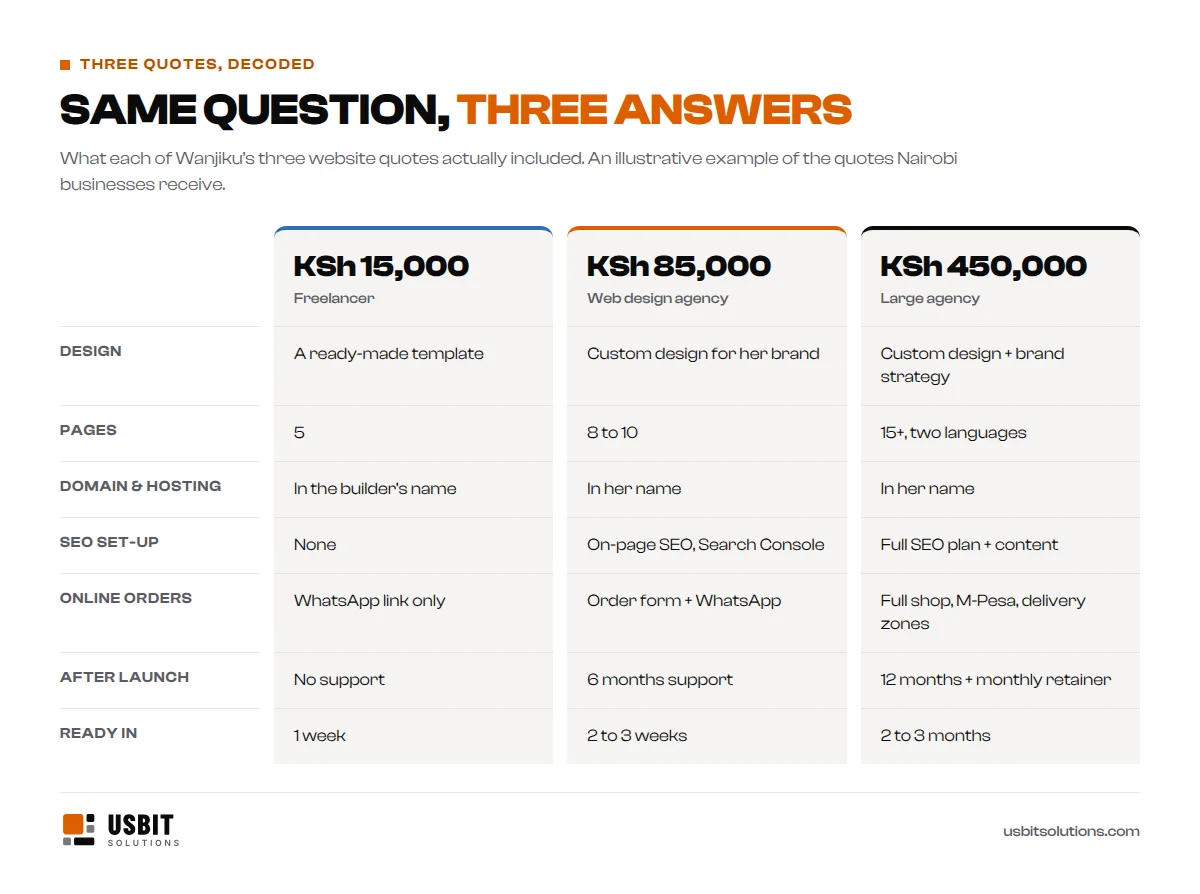
That was the moment it clicked: the three designers were not quoting for the same website. One priced a template, one priced a working business tool, and one priced a full digital operation. Once she compared what was inside each quote, the numbers stopped looking random.
A quick note: Wanjiku is a composite of the business owners who ask us this question every week, and her three quotes are typical of what Nairobi businesses receive.
What actually changes the price of a website?
Every quote in Kenya is built from the same six ingredients. Change any one of them and the price moves.
1. How many pages you need
A one-page site with your services and a WhatsApp button is quick to build. A ten-page site with a page for each service, an about page, a gallery and a blog needs more planning, more writing and more design. More pages, more hours.
2. A template or a custom design
Templates are cheaper because most of the design work is already done. The trade-off is that your site looks like thousands of others, and squeezing your business into someone else’s layout often costs time later. A custom design starts from your brand and your customers, which is why it costs more.
3. What the website has to do
This is the biggest price driver. A contact form is simple. Online bookings, customer accounts, M-Pesa and card payments, stock control or a members’ area each add real development and testing time. If a quote seems high, ask which features are driving it.
4. Who writes the words and takes the photos
Content is the most common reason websites are late. Many quotes assume you will supply all the text and photos. If you want a designer to write your copy or arrange a photo shoot, expect it to be priced separately.
5. Who builds it
Doing it yourself costs the least money and the most time. A freelancer can be excellent value for a simple site. An agency brings a team (design, development, SEO and support) and is accountable for the whole thing. You are paying for experience and for someone who answers the phone when something breaks.
6. What happens after launch
A website is not a poster. It needs security updates, backups and the odd change to prices or photos. Some quotes include a few months of support; others end the day the site goes live.
The costs nobody puts in the quote
Wanjiku’s next question was a good one: “Is that the full price, or will you bill me again next year?” Here are the running costs most Kenyan businesses should expect.
| Cost | How often | Typical price in Kenya | Good to know |
|---|---|---|---|
| Domain name (.co.ke) | Every year | KSh 1,000–2,000 | Register it in your own name. .ke domains are managed by KENIC. |
| Domain name (.com) | Every year | KSh 1,200–2,500 | Fine if you also sell outside Kenya. |
| Web hosting (shared) | Every year | KSh 1,000–10,000 | Bigger or busier sites need business or VPS hosting, which costs more. |
| SSL certificate (the padlock) | Every year | Free on most hosting plans | A free certificate is fine for most businesses. Be wary of paying extra for one. |
| Business email | Monthly or yearly | Free with many hosting plans | Google Workspace and Microsoft 365 charge per user, per month. |
| Care and maintenance | Every month | KSh 3,000–15,000 | Security updates, backups, monitoring and small edits. |
| M-Pesa payments | Per payment | Safaricom transaction charges | Connecting through Safaricom’s Daraja API is free; you pay the normal charges on each payment. |
None of these are scary on their own. The trouble starts when nobody mentions them, and the domain renewal email lands in someone else’s inbox.
The three-year maths: Achieng’s story
When Wanjiku told her friend Achieng about the KSh 15,000 quote, Achieng put her phone down. “Let me tell you about my salon website.”
Two years ago Achieng took the cheapest option. It looked fine for a few months. Then, around month eight, the site disappeared: the hosting had lapsed on the builder’s account and he had moved on to other work. Getting it back online cost KSh 8,000. By month fourteen she had had enough. Google could not find her, she could not change her own prices, and customers kept asking whether she was still open. She paid KSh 85,000 to have it rebuilt properly.
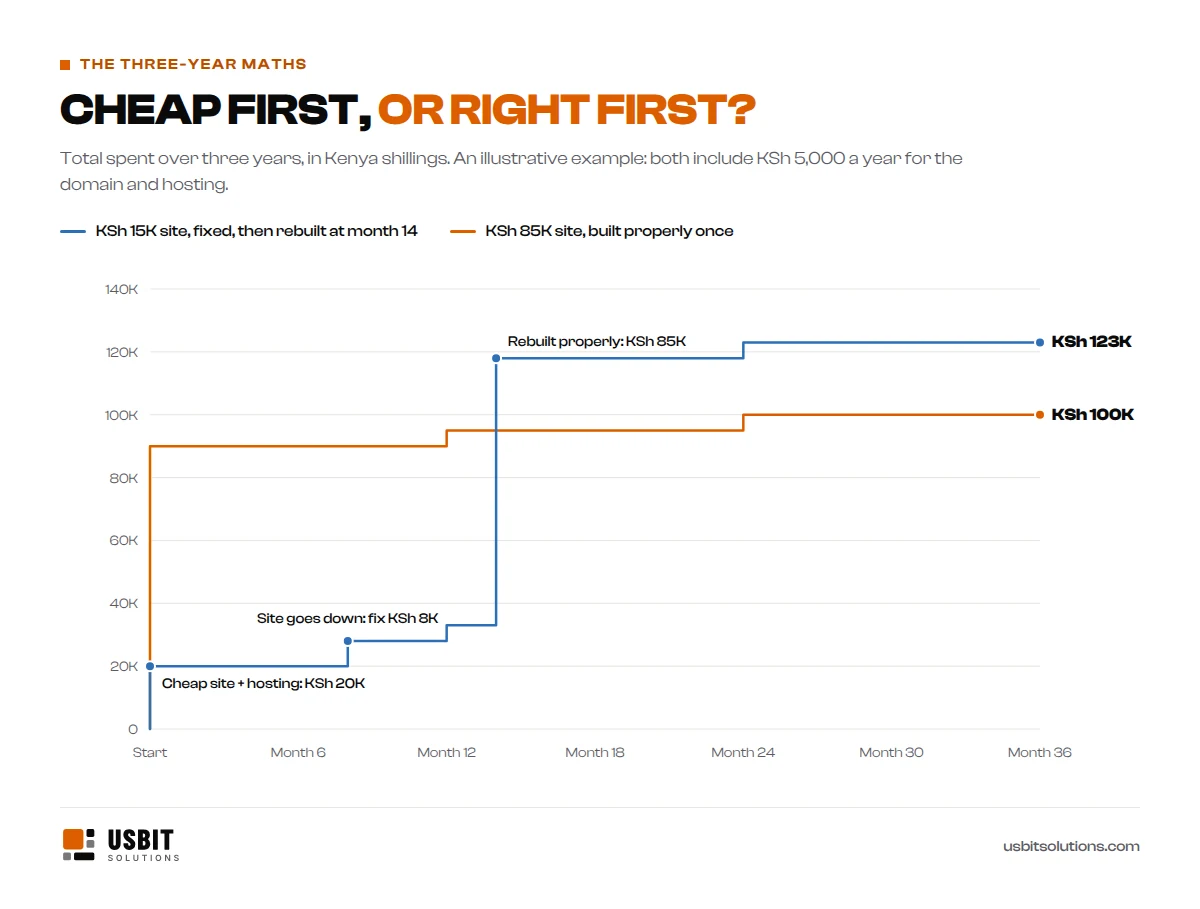
Add it up over three years and the “cheap” website cost Achieng KSh 123,000. Building it properly the first time would have cost KSh 100,000, without fourteen months of lost customers. Her cheap website was not cheap. It was a down payment on the real one.
Not every low-cost website ends like this. Plenty of freelancers do honest, good work. But if a quote leaves out who owns the domain, whether Google can find the site and what happens after launch, ask why before you pay.
DIY, freelancer or agency: which is right for you?
| Option | Upfront cost | Good for | Watch out for |
|---|---|---|---|
| Build it yourself | KSh 3,000–15,000 plus your time | Testing an idea, very small budgets | It eats your evenings, can look amateur and SEO is left to you |
| Freelancer | KSh 10,000–50,000 for a simple site | Simple sites with a clear brief | Who owns the domain and hosting, and what happens if they become unavailable |
| Agency | KSh 40,000–150,000+ for a business site | Businesses that want the website to bring enquiries and sales | Make sure you are not paying for features you do not need yet |
There is no shame in starting small. The best choice is the one that matches what you need the website to do this year, with room to grow next year.
How much does an online shop with M-Pesa cost?

In 2026, most online shops in Kenya cost KSh 60,000–300,000+ to build. A small catalogue with M-Pesa checkout sits at the lower end. Hundreds of products, several payment options, delivery zones, stock control and customer accounts push it up.
On M-Pesa specifically: connecting your shop through Safaricom’s Daraja API is free, so you are paying for the developer’s time to set it up and test it, plus Safaricom’s normal charges on each payment. Card payments go through a payment gateway that takes a small fee per transaction. And budget for good product photos. On an online shop, they do a lot of the selling.
Most shops take three to six weeks to build, depending on how many products you have and how ready your photos and descriptions are. You can see what goes into ours on our web design page.
What a website costs at USBIT Solutions
You have read this far, so it would be strange not to tell you our own prices. They are fixed, published and include VAT:
- Startup website: KSh 65,000 for a 3–5 page site, with your domain, hosting and email included.
- Business website: KSh 95,000 for a 5–10 page site, our most popular package.
- E-commerce website: KSh 120,000 for a full online shop with M-Pesa and card payments.
- Prefer to spread the cost? Monthly plans start at KSh 5,999 a month plus KSh 9,999 setup.
- Care after launch: care plans from KSh 3,500 a month.
Every package is listed side by side, with what is included, on our pricing page.
7 questions to ask before you pay a deposit
Many Kenyan web designers ask for 40–50% upfront. That is normal. Just get these answers first, in writing.

- Whose name will the domain and hosting be in? It should be yours. Otherwise you do not really own your website.
- Will I get the admin login when it is done? You should be able to change text, prices and photos yourself.
- How many pages, and who writes the words? Agree who supplies the text and photos, and by when.
- Is SEO set up? At the very least: page titles, speed, mobile-friendliness and Google Search Console.
- Does it take payments? If you sell online, ask about M-Pesa, card payments and who pays which fees.
- What happens after launch? How long is support included, and what do updates and backups cost each month?
- What is the timeline and payment plan? Get the dates and the payment stages written into your agreement.
What Wanjiku chose
In the end, the decision was easy. She did not need the KSh 450,000 website, not yet. And she realised she could not really afford the KSh 15,000 one either.
She chose the middle quote, made sure the domain was registered in her own name and asked for the order form to go straight to her WhatsApp, where her customers already are. When the bakery is ready to take payments online, the site can grow with it. She did not buy the cheapest website. She bought the right one for this year.
Website cost FAQs (Kenya)
How much does a website cost in Kenya in 2026?
Most small businesses pay KSh 40,000–150,000 for a professional website. Simple freelancer sites start around KSh 10,000, online shops with M-Pesa cost KSh 60,000–300,000+, and custom platforms can pass KSh 1,000,000. Add about KSh 3,000–10,000 a year for the domain and hosting.
How much does a domain name cost in Kenya?
A .co.ke domain usually costs about KSh 1,000–2,000 a year and a .com about KSh 1,200–2,500 a year. Always register it in your own name.
How much does web hosting cost in Kenya?
Shared hosting for a small business site costs about KSh 1,000–10,000 a year. Busy websites and online shops may need business or VPS hosting, which costs more.
How much does it cost to maintain a website in Kenya?
Expect about KSh 3,000–15,000 a month for security updates, backups, monitoring and small edits, depending on the size of the site. Our own care plans start at KSh 3,500 a month.
How much does M-Pesa integration cost?
Safaricom’s Daraja API is free to connect to. You pay for the developer’s time to set it up (usually included in an e-commerce package) and Safaricom’s normal charges on each payment.
Can I get a website for free in Kenya?
Free website builders exist, but they usually show the builder’s branding, use the builder’s web address and limit what you can do. For a business, a domain in your own name and basic hosting are worth the small yearly cost.
How long does it take to build a website?
A simple business website usually takes one to two weeks once the design is approved and the content is ready. Online shops take three to six weeks, and custom platforms can take several months.
Why do website quotes in Kenya vary so much?
Because the designers are usually quoting for different websites. Compare what each quote includes (pages, design, features, ownership, SEO and support) rather than the final number.
Got three quotes of your own?
Bring them to a free consultation. We will help you compare what each one actually includes and tell you honestly what your business needs this year, even if that turns out to be the smaller quote. Not sure how your current website is doing? Start with a free SEO health check.